The EOFY telco trap — don't get caught out this sale season
EOFY is a season where the pressure to "save" can quietly cost you more.

Every June, Australian inboxes start filling up with telco "EOFY specials". Bright colours, ticking countdowns, headlines screaming "50% off!" and "$30/month NBN!". And a few months later, the bill arrives and often quite a lot higher than the one you signed up for.
This article walks through what's actually going on inside the most common EOFY telco offers, in plain language. It's a companion piece to our earlier article on six-month promo periods (Is your telco promo actually saving you money?) but this one focuses specifically on the seasonal EOFY playbook, including two areas the previous article didn't cover: the "free" modem router catch and the fine print hiding inside SIM-only plans.
EOFY is one of the biggest telco sale events of the year and most of the headline "deals" are designed to look better than they are.
A "free" modem usually isn't free; it's typically paid off via a monthly credit you'll owe in a lump sum if you leave early (Reviews.org, 2024; WhistleOut, 2026a).
"Unlimited" SIM-only plans almost always come with a speed cap once you hit your real data limit, sometimes as slow as 256 Kbps (Reviews.org, 2026; TechRadar, 2026).
The smartest EOFY move is to compare the total cost over 24 months, not the headline monthly rate and to look for plans without promotional pricing in the first place.
Why EOFY is the riskiest sale season for telco shoppers
EOFY combines two things that make telco buying decisions worse: a "use it or lose it" mindset around tax-time spending, and a flood of time-limited offers designed to push you into signing up fast. The result is a season where people commit to longer contracts, larger plans and "free" hardware they'd never accept the rest of the year and where the real cost is buried in the fine print.
Telcos know that consumers are more receptive in June. You're already thinking about money, expenses, deductions and renewals. A "save $200 this EOFY" ad lands harder when you're mentally in budgeting mode. The trouble is, EOFY offers are usually shorter promo windows, larger upfront discounts and more aggressive bundling, meaning the gap between the sticker price and the long-term price is wider than usual.
Three traps come up over and over.
Trap #1: The introductory rate that disappears
Most "EOFY deals" you'll see advertised are introductory rates that revert to a much higher standard price after a fixed period, usually six months. By the time you notice, you're a year in and have already overpaid.
This is the classic six-month promo trap. A $60 plan that becomes $99 after six months costs $954 over twelve months, not $720. If the EOFY ad emphasises the introductory rate without showing the rollover price next to it, that's the trap.
Some major providers do the same thing with mobile plans. If you forget, and most people do, the higher price quietly takes over.
💡 What to check: Before signing, ask one question: "what's the price after the promo ends?" If the answer is more than 20% higher than the headline rate, treat the headline rate as the marketing, not the offer.
Trap #2: The "free" modem (which isn't free)
When a telco advertises a "free modem" with an EOFY plan, the modem is almost always being paid off as a monthly credit over 24 or 36 months. Stay the full term and you'll own it. Leave early, even though the plan itself has no lock-in contract, and you owe the remaining balance as a lump sum (Reviews.org, 2024; WhistleOut, 2026a).
This is one of the most misunderstood pieces of fine print in telco advertising. The "no lock-in contract" claim is technically true, the service is month-to-month, but the modem is on a payment plan. There's a second catch. Bundled modems from major providers might be configured specifically for that provider's network, meaning features like 4G backup, voice calling and even basic compatibility may not work if you switch providers, even after you've paid the modem off (WhistleOut, 2026a; Reviews.org, 2024). You're not just locked in financially, you may be locked into the hardware too.
💡 What to check: Ask explicitly: "If I cancel in six months, what do I owe on the modem?" If the answer involves a payout figure, the modem isn't free; it's financed.
Trap #3: The SIM-only plan deceptions
SIM-only plans hide more fine print than nbn plans, especially around the words "unlimited". Most "unlimited data" plans cap your speeds once you hit a real data threshold (Reviews.org, 2026; TechRadar, 2026).
Here are the two you'll see most often around EOFY.
The "unlimited data" myth
Across Australia, "unlimited" SIM plans share the same caveat: you get full speed up to a monthly data threshold, then get throttled for the rest of the cycle. Some telcos offer SIM only plans with unlimited data but capped download speed from 1 Mbps to 2 Mbps. (Reviews.org, 2026; TechRadar, 2026). At 1.5 Mbps you can browse and listen to music; at 256 Kbps, even loading a webpage gets painful.
Introductory mobile discounts
Some telco providers offer their SIM plans at half of their actual ongoing price with bonus data for first few months. Once the promo period is over, customers find cost of the plan is increased but data limit is decreased.
💡 What to check: Look for two numbers — the post-data-cap speed (anything under 1 Mbps is essentially unusable) and the plan's maximum download speed cap (this is the real ceiling, not the network type).
How Exetel's approach is different
Exetel's two consumer products — The One Plan for nbn, and Plus One for mobile — are deliberately built to avoid every trap above.
The One Plan (nbn). A flat $80/month for 500/50 Mbps (Typical Evening Speed 500/45) on FTTP or HFC. No promo period, so the price doesn't snap back at month seven. No bundled modem to pay off, bring your own. Add Hibernate to save $1/day when you're travelling, Warp Speed to upgrade your speed to 1000 Mbps (Typical evening speed 860/85 Mbps) for $1/day when you need it, and Refer a Friend for $1 off your bill per referral, as long as you both stay connected.
Plus One (mobile). A 5G eSIM plan on the Telstra Wholesale network (98.8% population coverage) for $40 per 30-day recharge, with 130GB of high-speed data, maximum speeds of 150 Mbps, and a Data Bank that rolls unused data forward up to 1000GB. Unlimited national calls and texts, unlimited international calls and SMS to 15 selected countries, and no lock-in contract, because it's prepaid.
The headline EOFY message is simple: the same price in month one, month seven, month thirteen and month thirty. No "deal expires" panic, no surprise modem payout, no buried throttle on the data plan. That's the whole offer.
Wrapping up
EOFY is a season where the pressure to "save" can quietly cost you more. The deals that look biggest in June are often the ones that hurt most by November — once the introductory rate has expired, the modem credit is still being clawed back, and the "unlimited" data has slowed to a crawl.
The shortcut for evaluating any EOFY telco offer is to ignore the headline number and look at three things: what you'll pay in month seven and beyond, what you'll owe if you leave, and what speed you'll actually get when you need it. If the answers are clean, it's probably a real deal. If they involve fine print, asterisks and "subject to change", it probably isn't.
Have a look at Exetel's One Plan for nbn and Plus One for mobile — flat-priced, no promo periods, no bundled hardware traps, and your payment receipts always at hand in the Exetel app.
Frequently Asked Questions
Are all EOFY telco deals bad?
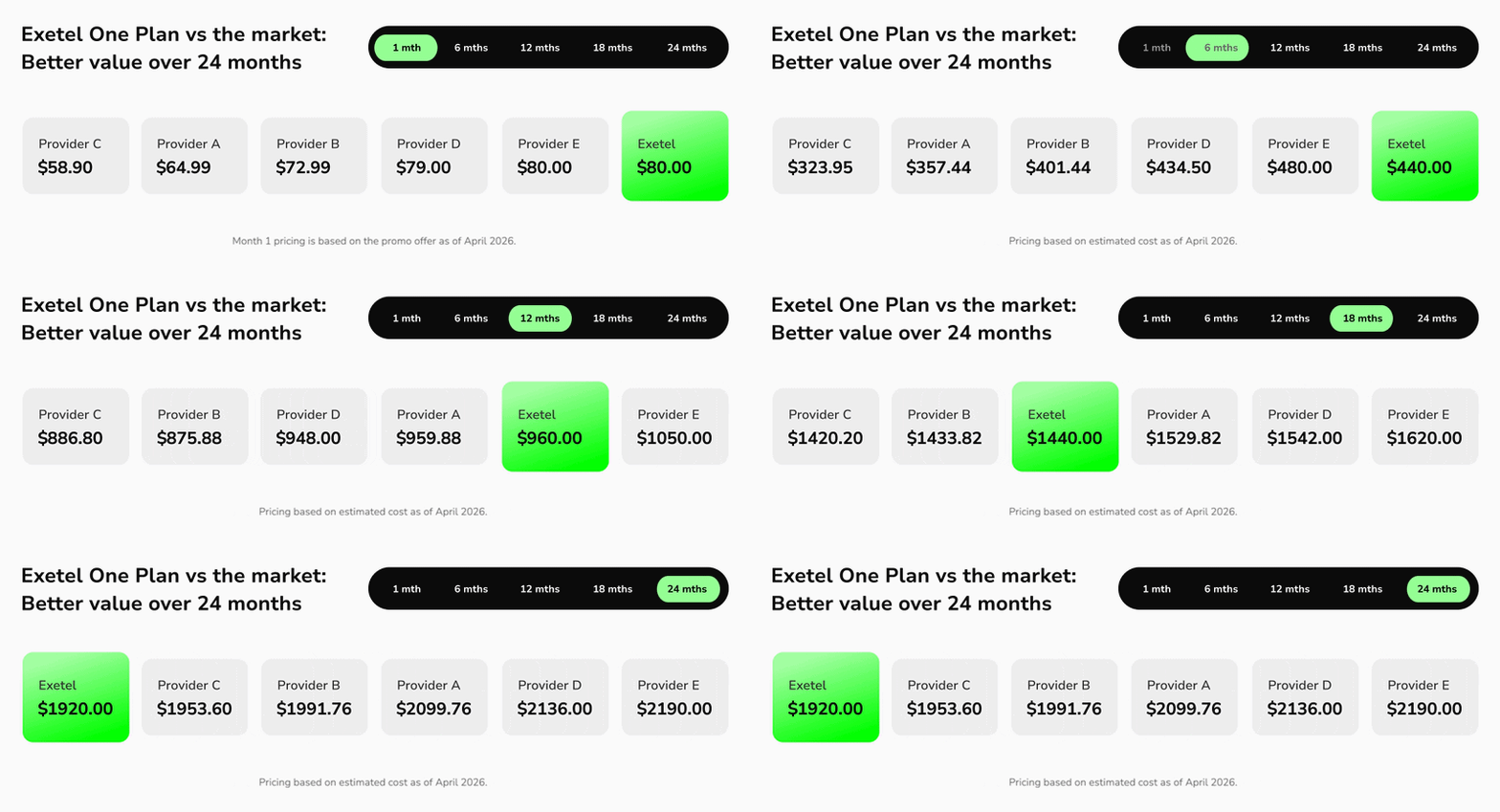
No, some can be genuinely good. The trick is to separate the headline rate from the long-term cost. A real deal looks the same in month one and month thirteen; a trap looks great in month one and very different in month seven. The trick is to find what is the value you’re getting in the long term. Promo pricing looks cheaper upfront, but consistency wins over time. Exetel The One plan stays at $80/month from day one, while many promo offers rise sharply after the discount period ends. Over 24 months, that consistency adds up.
Is a "no lock-in contract" the same as no commitment?
Not necessarily. The service may be month-to-month, but if the plan came with a "free" modem, you're often on a separate payment plan for the hardware, sometimes 24 to 36 months long (Reviews.org, 2024; WhistleOut, 2026a). Exit the service early and you owe the remaining modem balance.
What does "unlimited data" actually mean on a mobile plan?
In Australia, it almost always means unlimited at reduced speeds after a threshold. The high-speed allowance is your real data cap; once you cross it, your speeds drop — anywhere from 2 Mbps down to 256 Kbps depending on the provider (Reviews.org, 2026; TechRadar, 2026).
Is 150 Mbps fast enough for my 5G mobile plan?
150 Mbps is more than enough speed for everyday mobile use. To put it in perspective, streaming 4K content on Netflix requires around 25 Mbps per stream, which means a 150 Mbps connection could theoretically handle up to five simultaneous 4K Netflix streams without breaking a sweat. For a single user on a mobile service, that's serious headroom.
Most prepaid and SIM-only plans on the major networks come with maximum speeds that can vary between 100, 150 or 250 Mbps (WhistleOut, 2026c). The 5G label refers to the network technology, not the speed you'll experience.
Exetel's Plus One mobile plan delivers maximum speeds of 150 Mbps on Telstra’s Wholesale Mobile Network, paired with a generous 130GB data allowance that gives you plenty of speed and data for streaming, browsing, video calls and everything in between.
Should I switch providers during EOFY just for the savings?
Only if the long-term maths works, not just the first six or twelve months. If your current plan is fairly priced all year round and gives you what you need, the time and admin cost of switching usually outweighs the short-term saving. Switching makes the most sense when your current plan has snapped back to a high standard rate and there's a better-priced flat plan available.
Can I bring my own modem to avoid the modem trap?
In most cases, yes, and it's usually the cheapest option long-term. Many providers, including Exetel, support bring-your-own (BYO) modems. Just check that the modem is compatible with the provider's network technology and any voice/4G backup features you want.
References
Reviews.org. (2024, June 18). The best no contract NBN plans in Australia. https://www.reviews.org/au/internet/best-no-contract-nbn-plans/
Reviews.org. (2026). The best unlimited data mobile plans. https://www.reviews.org/au/mobile/best-unlimited-phone-plans/
TechRadar. (2026). Compare unlimited data mobile plans in Australia for 2026: plans from Optus, Vodafone, Telstra and more. https://www.techradar.com/phones/unlimited-data-mobile-plans-in-australia-which-providers-offer-them-and-are-they-worth-it
WhistleOut. (2026a). Best no lock-in contract NBN plans in Australia. https://www.whistleout.com.au/Broadband/Guides/no-contract-NBN-plans
WhistleOut. (2026b). NBN plans with a free modem. https://www.whistleout.com.au/Broadband/Guides/NBN-plans-with-a-free-modem
WhistleOut. (2026c). Exetel: First telco in Australia to offer just eSIM for mobile plans. https://www.whistleout.com.au/MobilePhones/News/Exetel-mobile-one-plan
Ringplanet (2026). How Many Mbps for Netflix: Every Speed Tier Explained So You Never Buffer Again. https://ringplanet.com/how-many-mbps-for-netflix/
Related Articles



© Copyright 2026 Exetel Pty Ltd. All rights reserved.